
Lauderdale Parole and Probation
Tennessee splits authority among three offices. The Tennessee Board of Parole decides whether parole should be granted. The Tennessee Department of Correction, or TDOC, supervises parolees and probationers. The sentencing court imposes probation and controls the underlying court order. That split matters in Lauderdale County, where the sheriff's jail in Ripley and two state prison facilities near Henning create very different release paths.
Parole is conditional release from prison before the sentence expires. A person can be out of prison yet still serve the sentence under TDOC supervision. Probation is a court-ordered community sentence. It may begin without state imprisonment, or it may follow a period of split confinement. A Board grant is not the physical release itself. TDOC says conditions and an approved release plan may still be required before a probation/parole officer approves the exit.
| Question | Parole | Probation |
|---|---|---|
| Who orders it? | Tennessee Board of Parole | Sentencing court |
| What comes before it? | A state prison term | May follow no prison term or split confinement |
| Who supervises it? | TDOC community supervision | TDOC community supervision when assigned |
| Best public starting point | FOIL status and Board record | FOIL status and court order |
| What ends it? | Final discharge or sentence expiration | Court or agency discharge under the sentence |
Verify Lauderdale Post-Release Supervision
Start with TDOC Felony Offender Information Lookup, called FOIL. The system covers current and former felony offenders in TDOC custody or supervision. Search by exact name, TOMIS or TDOC number, or State ID when known. Match date of birth, photo, offense, and other identifiers before selecting a result. A public status of parole or probation shows community supervision, but it does not explain every condition or prove the date supervision will end.
- Identify whether the last known custodian was Lauderdale County Jail, West Tennessee State Penitentiary, or Women's Therapeutic Residential Center.
- Search FOIL and preserve the exact status, date label, location, and access date shown on the matched record.
- For parole, obtain the individual decision record from the Board using the person's name and TDOC number.
- For probation, request the judgment, probation order, and later revocation or discharge entries from the sentencing clerk.
- Use TDOC District 61 for office routing, while recognizing that staff may protect details not available to the public.
The local clerk is Jodie Edwards, Circuit Court Clerk. The county and Tennessee Courts directories give 731-635-0101 and jodie.edwards@tncourts.gov. Ask which court holds the case because General Sessions and Circuit or Criminal Court records can answer different stages of one matter. A docket entry is more reliable than an inference from a blank online result.
Lauderdale Supervision at District 61
TDOC's community supervision field-office directory assigns Lauderdale County to District 61 in Dyersburg. The directory marks the St. Johns Avenue location as new as of November 3, 2025 and states that the office serves both Dyer and Lauderdale counties. Call before visiting to confirm office logistics and the right way to direct an inquiry.
2155 St. Johns Avenue
Dyersburg, TN 38024
Phone: 731-288-7910
Fax: 731-288-7925
The official directory image shows the Lauderdale-serving office in its statewide context.
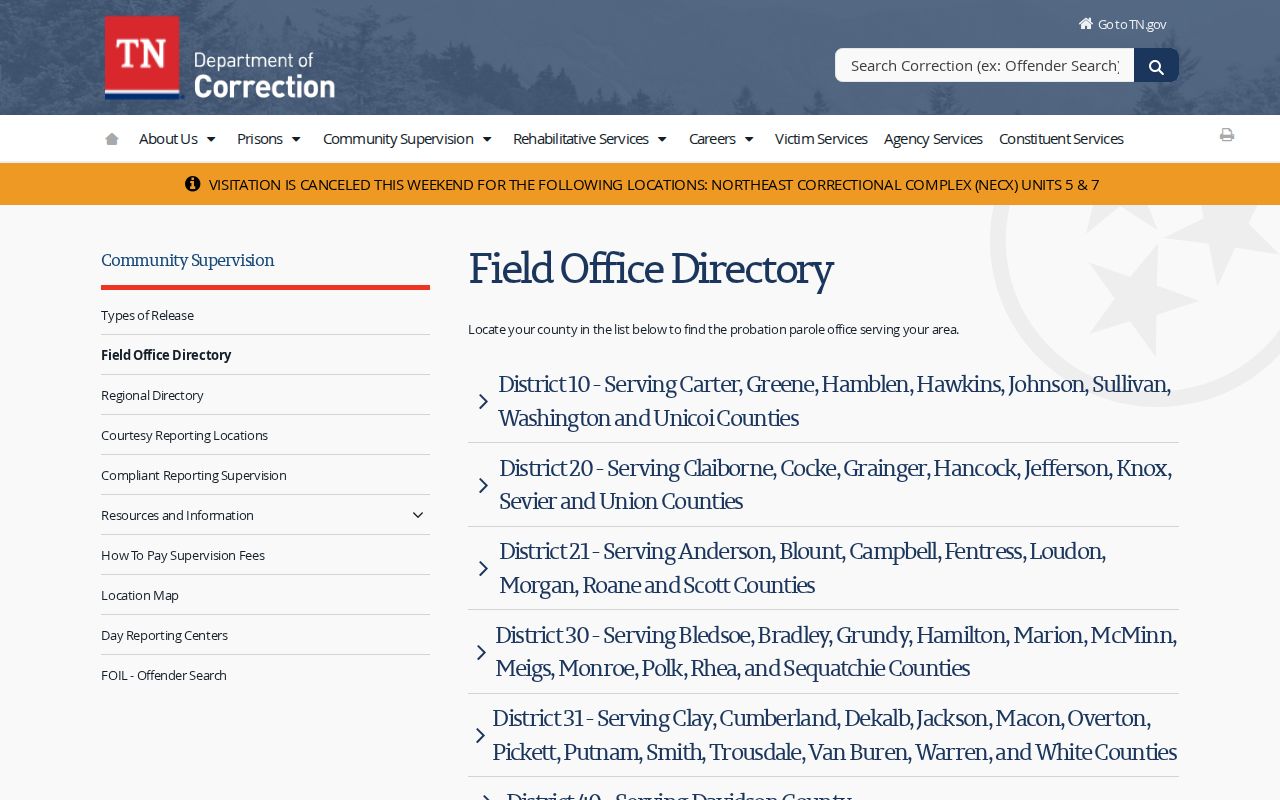
Use the office for supervision routing, not as a substitute for the Board's parole decision or the court's probation order. Public status can be checked in FOIL, while details about conditions or an individual case may be limited.
Lauderdale Release Status Meanings
The TDOC Types of Release material distinguishes parole, probation, determinate release, and mandatory reentry supervision. It also states that a person placed on probation, or released from split confinement, must report to the probation/parole officer within 48 hours. That reporting rule does not turn probation into parole. The source of authority remains the court for probation and the Board for parole.
Determinate release is described as a form of special probation under Tennessee Code section 40-35-501 for qualifying one-to-two-year felony sentences after the required portion, subject to notice and objection rules. Mandatory reentry supervision under section 40-35-506 has its own conditions. Neither label should be guessed from the fact that someone is in the community. Preserve the exact record term and confirm the controlling order.
The official TDOC image below emphasizes why approval and physical release must be kept apart.
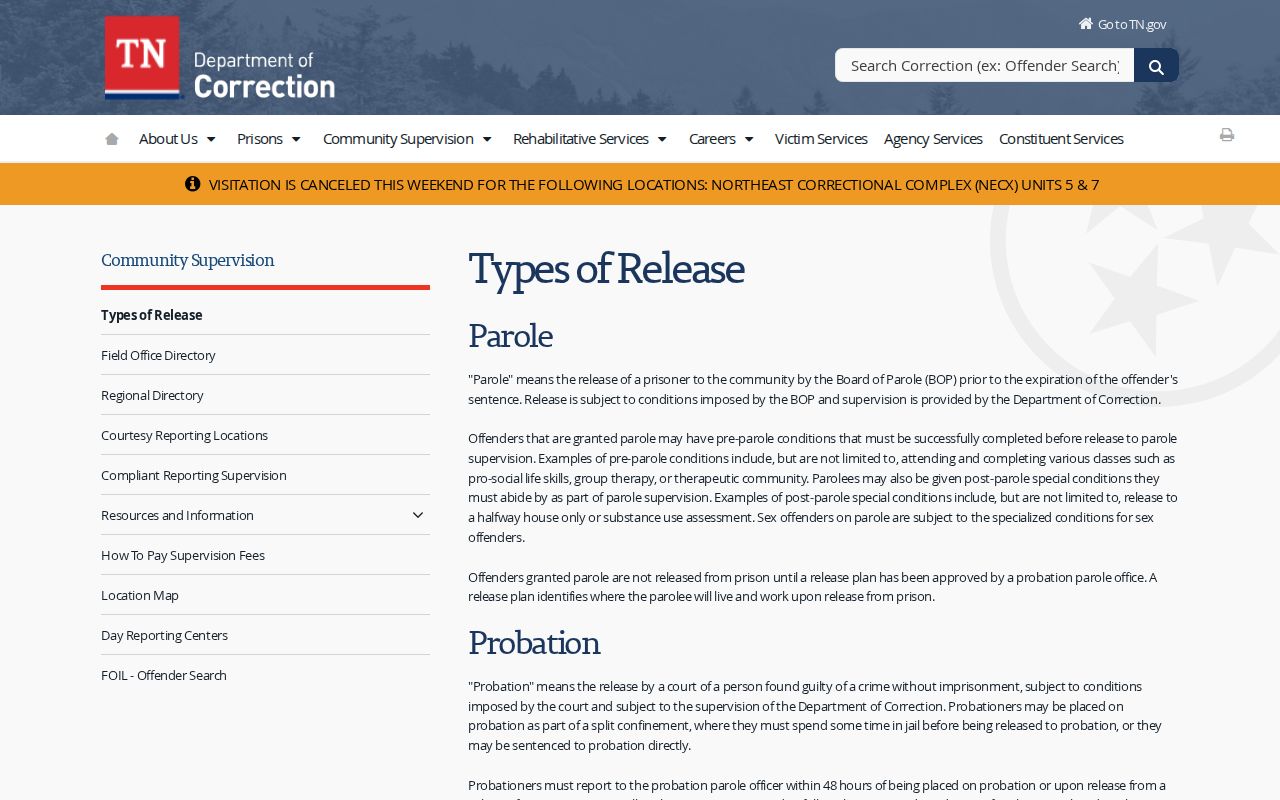
The displayed release types provide definitions, while FOIL, the Board file, and the court record supply the person-specific evidence.
- Parole
- Conditional release from prison before sentence expiration, under supervision.
- Probation
- A community sentence imposed by a court, sometimes after split confinement.
- Discharge
- The formal end of the sentence or supervision status shown by the responsible authority.
- Absconder
- A person alleged to have stopped reporting or left supervision without authorization.
Lauderdale Supervision Violations
No verified Lauderdale County absconder list or county warrant list was found. Do not infer a violation from a missed update or a person's absence from VINELink. FOIL may show a public supervision status, but a warrant or absconder claim needs an official source. When the record concerns probation, request later court entries. When it concerns parole, use the Board and TDOC channels tied to the correct TOMIS number.
A violation allegation does not erase the earlier release. Revocation is the process that may return a person to custody after a claimed breach. The Board's official materials describe preliminary and final revocation hearings, as well as reinstatement and rescission processes. If custody changed, record each event in order: prison release, start of supervision, alleged violation, warrant or hearing, and any new custody event.
VINELink can provide a custody alert when a participating agency reports a change. It is not a supervision case file. No result may reflect spelling, feed coverage, timing, transfer, or data retention. Confirm a new arrest or custody event with the reporting agency and the court rather than using an alert as the final legal record.
There is also no verified public database of final Tennessee parole decisions. The Board publishes hearing information and offers an individual public-record request route. Current state-prison and county-jail hearing schedules are updated weekly each Monday, or Tuesday after a Monday holiday, and schedule requests go to BD.HearingSchedules@tn.gov. A schedule shows that a hearing is set. It does not state the final outcome, release-plan approval, or actual release time.
For a final Board record, include the person's full name and TDOC number. The Board lists BOP.Webmail@tn.gov and 615-741-1150, with its Public Records Request Coordinator at 500 James Robertson Parkway, 4th Floor, Nashville, TN 37243-0850. Its records page says proof of Tennessee citizenship is required, inspection is by appointment, and fees may apply. Ask for the specific decision rather than a broad search that the agency does not publish.
Lauderdale Reentry After Release
Lauderdale County has a notable state-prison reentry setting because West Tennessee State Penitentiary and Women's Therapeutic Residential Center operate near Henning. TDOC reported that 120 people at WTSP and WTRC graduated from education and training programs in June 2025. That number describes a program event. It does not show that any named person was released, granted parole, or qualified for a service.
The Tennessee Reentry Collaborative is a statewide community-resource navigation layer. It may help a released person locate support, but eligibility and availability must be checked with each provider. Keep program information separate from supervision proof. FOIL and official records answer status questions; a resource directory does not.
For a release from Lauderdale County Jail, Sheriff Brian Kelley's office is the local custody source. First determine whether the event was a true community exit or a transfer. A person moved to TDOC may later appear in FOIL as incarcerated. Someone released from WTSP or WTRC on parole may be assigned to District 61. The same county name does not make those records interchangeable.
Lauderdale Supervision Discharge Records
Supervision ends through the authority responsible for the sentence. FOIL may show an inactive status and release or sentence information, but its public overview does not promise identical fields on every record. Record the exact wording. If a date or label is unclear, use TDOC Sentence Information for an active or recent sentence and TDOC Records Management or GovQA for archived records.
For a probation case, ask the sentencing clerk for the judgment, probation order, and any later discharge or revocation order. For parole, request the relevant Board record and compare it with FOIL. Tennessee public-record rules permit exemptions and redactions, so ask for the segregable public fields and a written basis for withheld material. The complete Lauderdale County release search also explains how to pair the court authority with the custodian's actual exit record.
The Tennessee Public Records Act begins at section 10-7-503. If prompt production is not practical, the seven-business-day framework allows production, a denial with legal basis, or a written estimate of availability. It is not a promise that every record arrives within seven days. A narrow request naming the person, TDOC number, date range, and exact decision or discharge record is easier to route and less likely to mix different cases.
Keep eligibility, release, supervision, and discharge as four distinct milestones. A person can be eligible without being granted parole, granted without leaving that day, released while still supervised, and later discharged. That sequence prevents a public status from being stretched beyond what it proves.
Note: Verify dynamic FOIL and office information on the day of use because record fields, locations, and procedures can change.